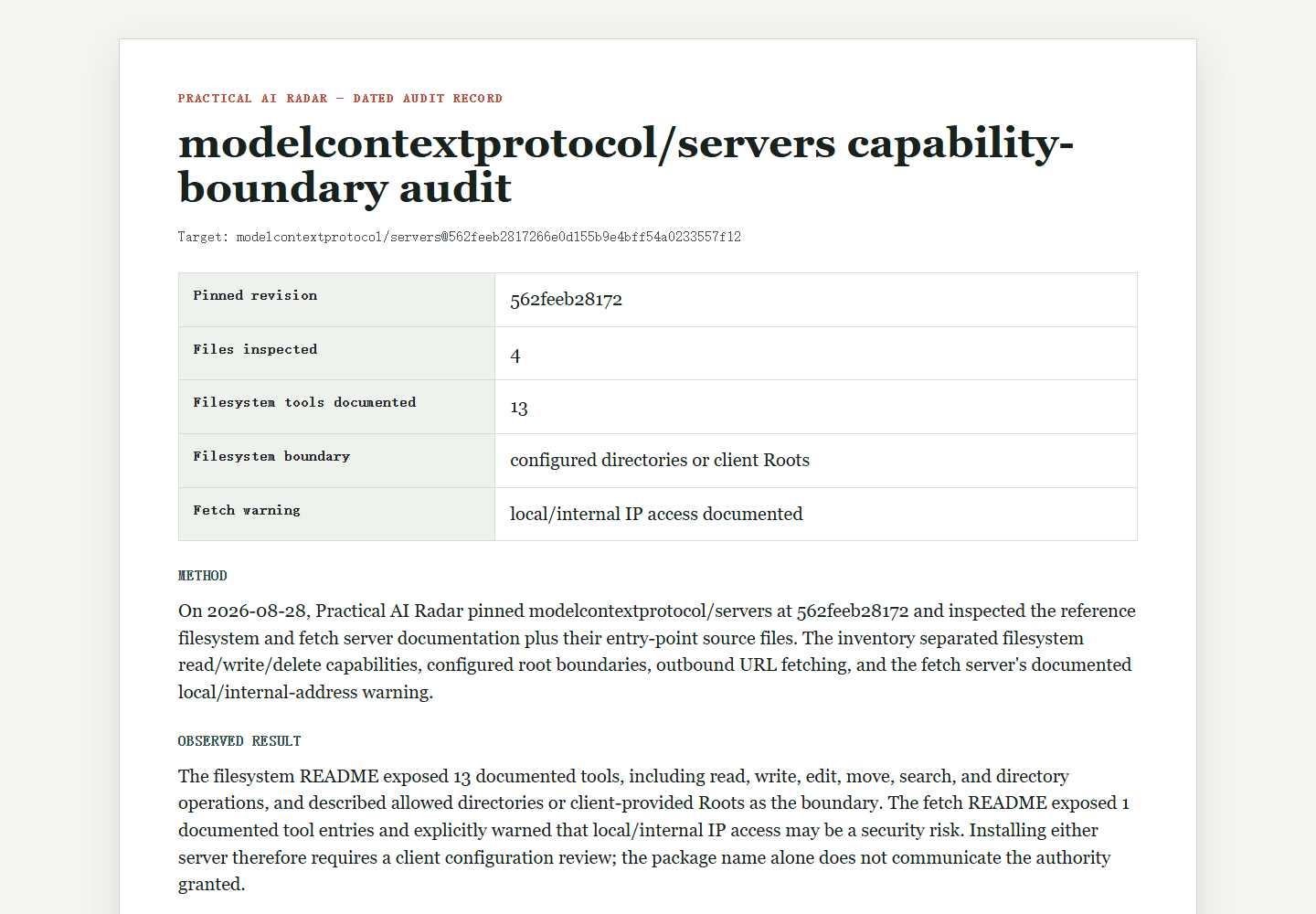
An MCP server can make useful capabilities available to an AI client, but the friendly tool name in the client is not the security boundary. The server process may read local files, call remote services, inherit environment variables, or perform writes with the credentials you provide. The official reference-server repository explicitly describes its examples as educational rather than production-ready. Treat installation as a small integration review: enumerate side effects, reduce authority, test denial, and keep an artifact showing exactly what was connected.
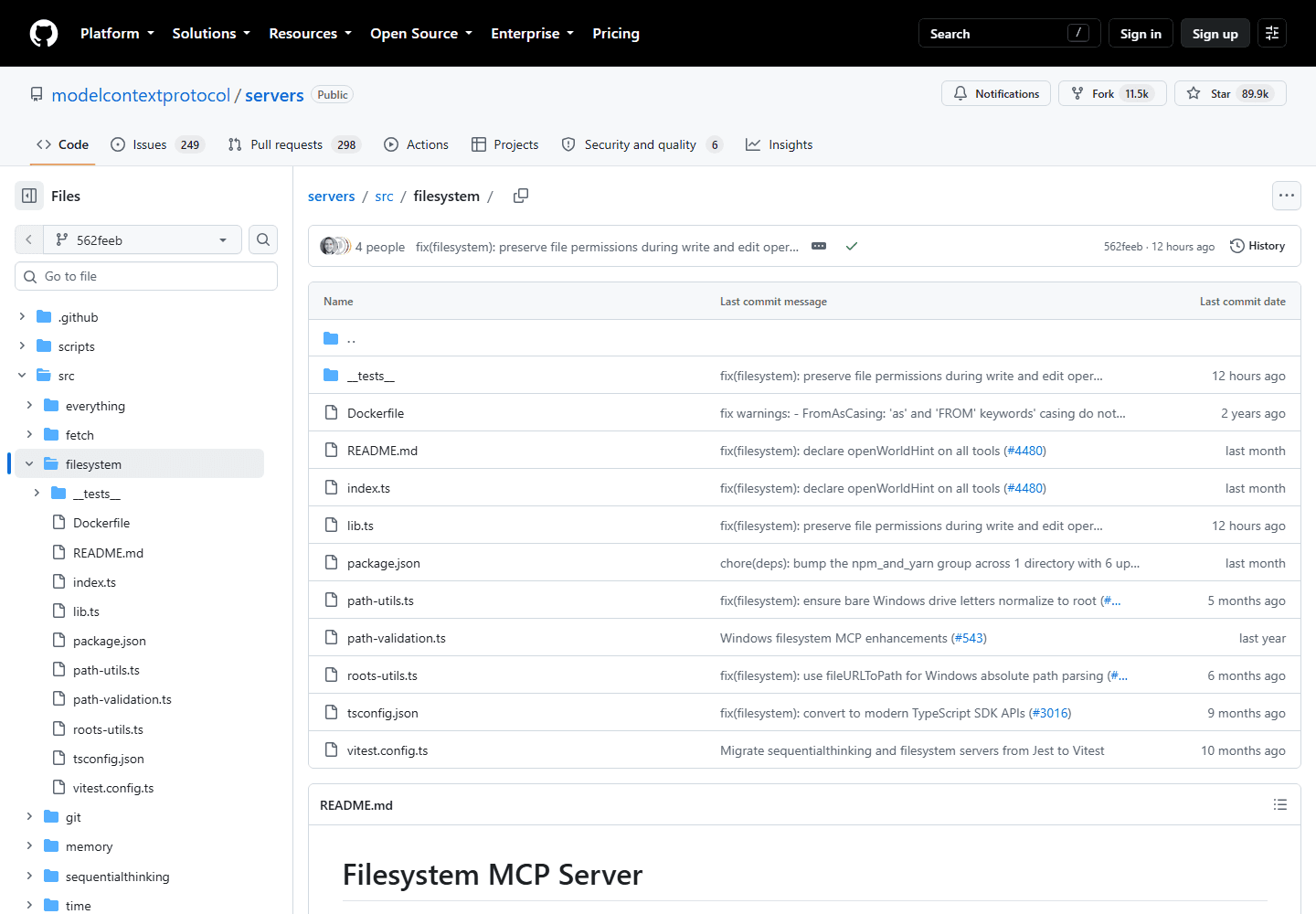
The server behind the directory listing
Record the canonical repository, package name, version or commit, maintainer, license, release channel, and installation command. Confirm that the package being installed maps to the repository you inspected. Look for recent ownership changes, archived status, generated install scripts, and dependencies fetched from elsewhere. Popularity and inclusion in a directory do not establish production suitability.
Write the intended use in one line: “read issues from one test repository,” for example, is a boundary. “Help with GitHub” is not. List the data classes involved: public source, private source, customer data, credentials, local documents, or deployment controls. If the use cannot be stated narrowly, do not connect a broad account to discover what the server does.
What side effect sits behind each tool?
Inspect the server’s tool definitions and implementation. Build a table that separates the visible action from the authority behind it.
| Tool or resource | Reads | Writes | Network destination | Credential |
|---|---|---|---|---|
| repository search | selected repository | none expected | Git provider API | read-only token |
| issue creation | prompt and repository state | issue content | Git provider API | issue-scoped token |
| local file lookup | configured directory | none expected | none | operating-system access |
Check whether arguments can select a different repository, path, host, or account than the one shown in the UI. Look for shell execution, arbitrary URL fetching, path traversal, redirect handling, symlink behavior, and logs that include tokens or document contents. Tool descriptions are claims; implementation and an isolated run are evidence.
Why use a disposable identity?
Use a disposable account, repository, directory, or project. Create a credential with the smallest documented scope and a short lifetime. Do not reuse a browser session cookie or a broad personal token. Keep secrets outside command-line arguments and source files, and verify where the client stores server configuration.
For local files, create a test directory containing one allowed file and one decoy secret outside the boundary. For network services, create one allowed project and a second project the token should not access. The negative case matters: a successful read only proves that access works; a denied read demonstrates that the boundary exists.
Test three requests: allowed, denied, and ambiguous
Run a harmless read with expected output. Then request an out-of-scope path or resource and preserve the denial. Next, phrase an ambiguous instruction that could cause a write and check whether the client asks for confirmation, the server rejects it, or the operation proceeds. Never test destructive behavior against real data.
Capture the server version, client version, configuration with secrets removed, tool list, process permissions, outbound destinations, and observed results. If the server uses OAuth, verify the official flow and audience rules; the MCP security guidance warns against token passthrough and confused-deputy designs. A token issued for one service must not silently become a credential for another.
The connection needs a process boundary
Run the server as an unprivileged user or inside an appropriate container or sandbox. Mount only required directories, preferably read-only. Restrict outbound network access where practical. Avoid inheriting the full parent environment. Separate read-only and write-capable servers so a useful search tool does not automatically gain modification rights.
Define an approval step for consequential writes and show the destination before execution. The model’s intent is not authorization. The server must enforce access controls independently, and the human interface should make account, resource, and side effect visible.
Updates change the reviewed artifact
An unchanged repository URL does not guarantee an unchanged package. On update, compare the lockfile or package metadata, install scripts, newly introduced dependencies, requested scopes, tool list, and outbound destinations. Preserve the previous known-good package or image digest long enough to roll back. If the client updates servers automatically, disable that behavior for privileged integrations or place updates behind a staging profile. A review tied only to a project name expires as soon as different code is installed under that name.
Can the connection be revoked quickly?
The adoption record should state the pinned version, permitted tools, identity and scopes, local mounts, network allowlist, denied test results, log location, owner, and refresh triggers. Include how to revoke the credential and remove the server configuration. Recheck after a version change, new tool, new maintainer, client update, or broader data access.
The result may be “use only in the disposable lab,” which is a valid decision. An MCP server becomes appropriate for real work when its authority is narrower than the task, denial works, and another person can reproduce the review without trusting a directory listing or an appealing demo.